Women’s access to and participation in economic activities in the natural resources sectors in Nepal: Insights from a sectoral policy review
DOI:
https://doi.org/10.53037/na.v9i1.131Keywords:
women’s economic empowerment, policy analysis, policy implementation, policy harmonisation, coherenceAbstract
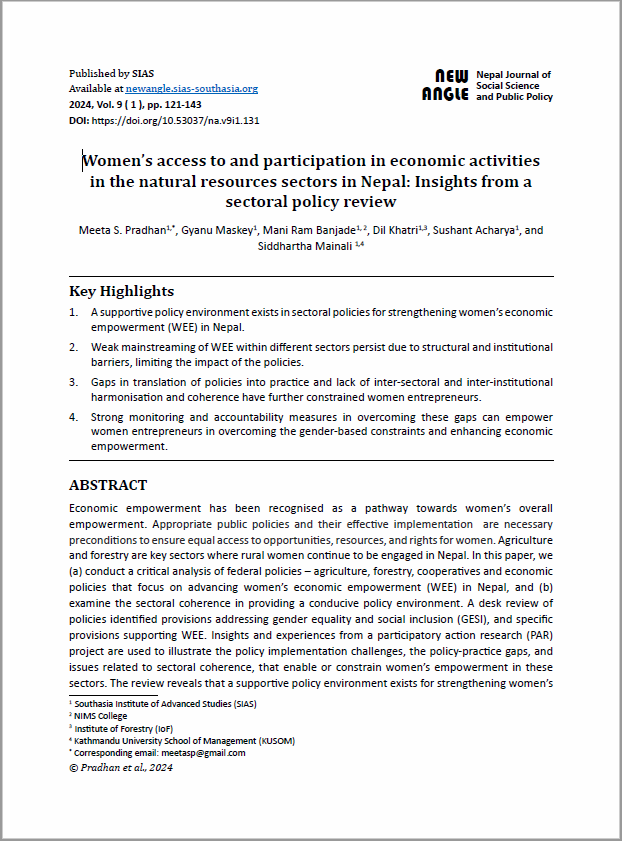
Economic empowerment has been recognised as a pathway towards women’s overall empowerment. Appropriate public policies and their effective implementation are necessary preconditions to ensure equal access to opportunities, resources, and rights for women. Agriculture and forestry are key sectors where rural women continue to be engaged in Nepal. In this paper, we (a) conduct a critical analysis of federal policies – agriculture, forestry, cooperatives and economic policies that focus on advancing women’s economic empowerment (WEE) in Nepal, and (b) examine the sectoral coherence in providing a conducive policy environment. A desk review of policies identified provisions addressing gender equality and social inclusion (GESI), and specific provisions supporting WEE. Insights and experiences from a participatory action research (PAR) project are used to illustrate the policy implementation challenges, the policy-practice gaps, and issues related to sectoral coherence, that enable or constrain women’s empowerment in these sectors. The review reveals that a supportive policy environment exists for strengthening women’s economic status. However, weak mainstreaming of WEE across different sectors persists due to structural and institutional barriers. There are gaps in the translation of policies into practice, and poor inter-sectoral and inter-institutional harmonisation and coherence limit the potential for more sustained positive impact on the ground.
References
Acharya, M. (2024) ‘Foreword’, in Klatzer, E., Tamrakar, N. and Adhikari, N.H. (eds.) Advancing gender equality in Nepal: Refining gender-responsive budgeting for transformative impact. Lalitpur, Nepal: Friedrich-Ebert-Stiftung Nepal Office.
Acharya, S. et al. (2025) ‘Building collective capabilities to respond to Gender-based Constraints in smallholder farming: A case from rural Nepal’, Journal of Human Development and Capabilities. 27(1), pp. 105-127. doi: https://doi.org/10.1080/19452829.2025.2578227 DOI: https://doi.org/10.1080/19452829.2025.2578227
Aziz, A., Shams, M. and Khan, K.S. (2011) ‘Participatory action research as the approach for women’s empowerment’, Action Research 9(3). Pp. 303-323. doi: https://doi.org/10.1177/1476750310396952 DOI: https://doi.org/10.1177/1476750310396952
Baker Tilly (2023) Nepal Tax Fact 2023/24 (2080/81). Major Taxation Provisions including Changes by Finance Bill, 2080 (2023). Available at: (https://bakertilly.com.np/storage/download/1685939601_Tax_Fact_2023-24.pdf) (Accessed: September 22 2023).
Banjade, M.R. et al. (n.d.) ‘Policy translation challenges in the Agriculture Sector in Nepal’, (Forthcoming)
Baral, S., Tiwari, S. and Shrestha, K.K. (2024) ‘Gendered process of women (dis)empowerment in the community forestry in Nepal’, Journal of Forest and Livelihood. 24 (1), pp. 1-21.
Baulenas, E., Kruse, S. and Sotirov, M. (2021) ‘Forest and water policy integration: A process and output‐oriented policy network analysis’, Environmental Policy and Governance, 31(5), pp. 432-450. DOI: https://doi.org/10.1002/eet.1951
Buchy, M. and Shakya, S. (2023) ‘Understanding the gap between the gender equality and social inclusion policy and implementation in the energy sector: The case of Nepal’, Energy for Sustainable Development. 76. doi: https://doi.org/10.1016/j.esd.2023.101297 . DOI: https://doi.org/10.1016/j.esd.2023.101297
Center for Social Change (2024) Nepal and GEDSI: A brief overview of policy level commitments and actions. Kathmandu, Nepal. Available at: https://socialchange.org.np/wp-content/uploads/2024/03/Nepal-and-GEDSI-centre-for-social-change-2024.pdf
Chaudhary, A., Babu, S. and Srivastava, N. (2025) Integrating agriculture policies with climate change strategies and commitments in Nepal. Washington, DC: International Food Policy Research Institute (IFPRI). Available at: https://cgspace.cgiar.org/server/api/core/bitstreams/a644102d-1e3e-48d0-ae5f-a759586fb7f8/content
Christensen, T., Lægreid, O.M. and Lægreid, P. (2019) ‘Administrative coordination capacity; does the wickedness of policy areas matter?’, Policy and Society, 38(2), pp. 237–254. DOI: https://doi.org/10.1080/14494035.2019.1584147
Darjee, K.B. et al. (2021) ‘Do national policies translate into local actions? Analyzing coherence between climate change adaptation policies and implications for local adaptation in Nepal’, Sustainability, 13. doi: https://doi.org/ 10.3390/su132313115 DOI: https://doi.org/10.3390/su132313115
Devkota, R. et al. (2022) ‘Rethinking gender mainstreaming in agricultural innovation policy in Nepal: A critical gender analysis’, Agriculture and Human Values, pp. 1373–1390. doi: https://doi.org/10.1007/s10460-022-10326-1 DOI: https://doi.org/10.1007/s10460-022-10326-1
See more in PDF
Downloads
Published
Issue
Section
License
Copyright (c) 2024 Pradhan et al.

This work is licensed under a Creative Commons Attribution-NonCommercial 4.0 International License.
How to Cite