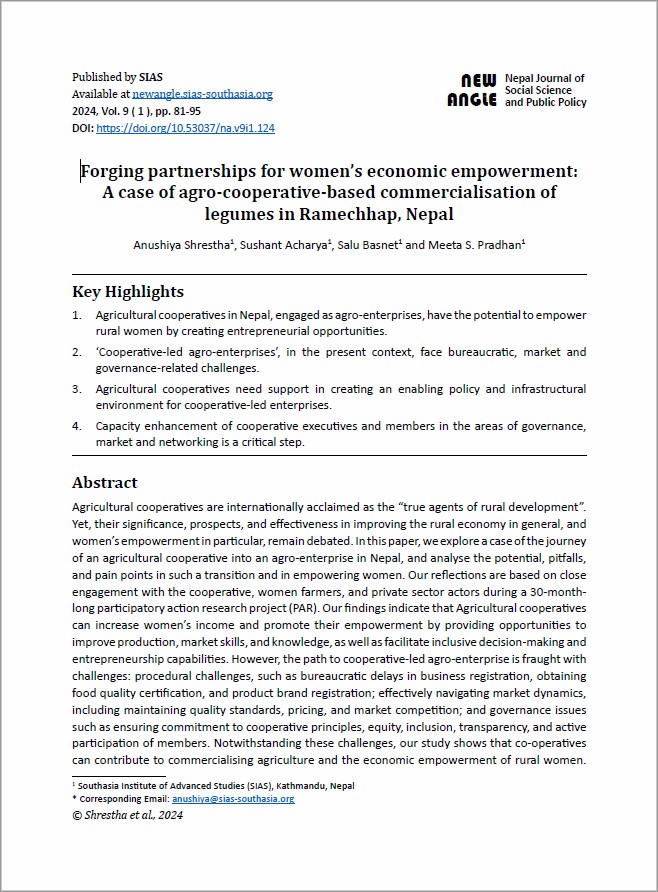
Forging partnerships for women’s economic empowerment: A case of agro-cooperative-based commercialisation of legumes in Ramechhap, Nepal
DOI:
https://doi.org/10.53037/na.v9i1.124Keywords:
agricultural cooperatives, challenges, cooperative-led-enterprises, potentials, women’s economic empowermentAbstract
Agricultural cooperatives are internationally acclaimed as the “true agents of rural development”. Yet, their significance, prospects, and effectiveness in improving the rural economy in general, and women’s empowerment in particular, remain debated. In this paper, we explore a case of the journey of an agricultural cooperative into an agro-enterprise in Nepal, and analyse the potential, pitfalls, and pain points in such a transition and in empowering women. Our reflections are based on close engagement with the cooperative, women farmers, and private sector actors during a 30-month-long participatory action research project (PAR). Our findings indicate that Agricultural cooperatives can increase women’s income and promote their empowerment by providing opportunities to improve production, market skills, and knowledge, as well as facilitate inclusive decision-making and entrepreneurship capabilities. However, the path to cooperative-led agro-enterprise is fraught with challenges: procedural challenges, such as bureaucratic delays in business registration, obtaining food quality certification, and product brand registration; effectively navigating market dynamics, including maintaining quality standards, pricing, and market competition; and governance issues such as ensuring commitment to cooperative principles, equity, inclusion, transparency, and active participation of members. Notwithstanding these challenges, our study shows that co-operatives can contribute to commercialising agriculture and the economic empowerment of rural women. For successful transition, rural agricultural cooperatives, however, need government support and an enabling policy environment to promote their multi-functional nature. Additionally, it is essential to strengthen cooperatives’ internal governance, improve access to market information systems, and address financial, structural, and infrastructure barriers that impede interest and involvement in cooperatives.
References
Bhattarai, R. and Pandit, M. (2023) ‘Cooperatives as pillar of economy to improve agriculture production and marketing’, Nepal Public Policy Review, 3(1), pp. 221-238. doi: https://doi.org/10.59552/nppr.v3i1.61
Dhakal, D. and Mueser, P. (2023) ‘Agricultural cooperatives and the failure to achieve commercialization of agriculture in Nepal: A case study of the Chitwan district’, Research in Globalization, 7.
Dendup, T. and Aditto, S. (2020) ‘Performance and challenges of Agricultural cooperatives in Bhutan’, Khon Kaen Agriculture Journal, 48, pp. 1194-1205.
Dhakal, D., O’Brien, D. and Mueser, P. (2021) ‘Government policy and performance of agricultural cooperatives: A case study in Chitwan District, Nepal. Sustainability, 13. doi: https://doi.org/ 10.3390/su132112282...
Downloads
Published
Issue
Section
License
Copyright (c) 2024 Shrestha et al.

This work is licensed under a Creative Commons Attribution-NonCommercial 4.0 International License.
How to Cite