Multispecies triads and intersectionality of agriculture in Nepal: Gendered human-plant-bovine engagements
DOI:
https://doi.org/10.53037/na.v9i1.137Keywords:
bovines, gender, multi-species triad, plants, women’s economic empowermentAbstract
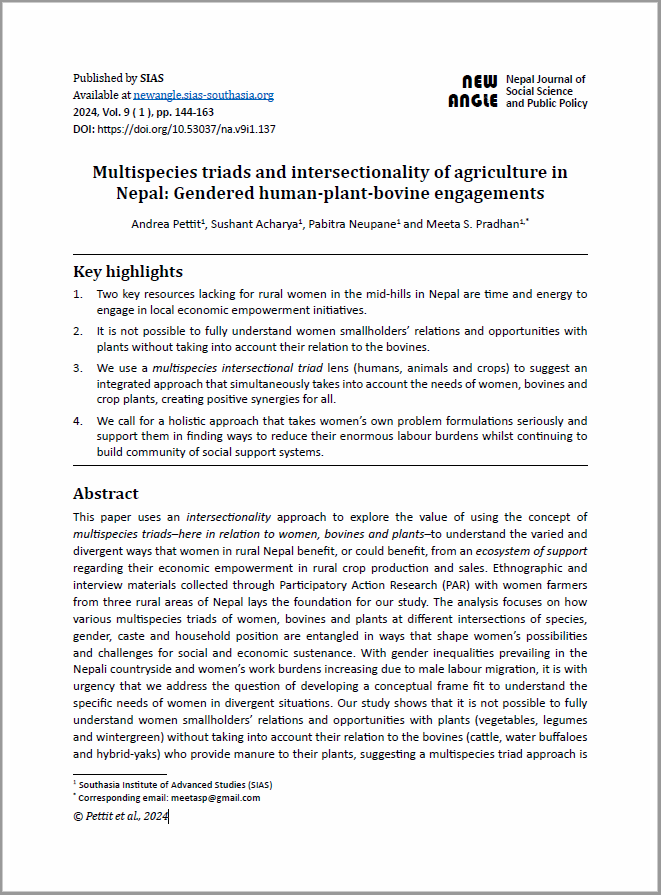
This paper uses an intersectionality approach to explore the value of using the concept of multispecies triads–here in relation to women, bovines and plants–to understand the varied and divergent ways that women in rural Nepal benefit, or could benefit, from an ecosystem of support regarding their economic empowerment in rural crop production and sales. Ethnographic and interview materials collected through Participatory Action Research (PAR) with women farmers from three rural areas of Nepal lays the foundation for our study. The analysis focuses on how various multispecies triads of women, bovines and plants at different intersections of species, gender, caste and household position are entangled in ways that shape women’s possibilities and challenges for social and economic sustenance. With gender inequalities prevailing in the Nepali countryside and women’s work burdens increasing due to male labour migration, it is with urgency that we address the question of developing a conceptual frame fit to understand the specific needs of women in divergent situations. Our study shows that it is not possible to fully understand women smallholders’ relations and opportunities with plants (vegetables, legumes and wintergreen) without taking into account their relation to the bovines (cattle, water buffaloes and hybrid-yaks) who provide manure to their plants, suggesting a multispecies triad approach is of value. In line with this, we lean towards a holistic approach, suggesting that efforts to couple common place commercial solutions for women’s economic empowerment with innovative non-commercial aspects of ecosystems of support, such as labour exchanges, care pooling and time sharing, could be worthwhile.
References
See more in the PDF.
Downloads
Published
Issue
Section
License
Copyright (c) 2024 Pettit et al.

This work is licensed under a Creative Commons Attribution-NonCommercial 4.0 International License.
How to Cite